
Step 4 of 16
0 of 16 steps finished
Module 1: Digital badge foundations
Badges, certificates and micro-credentials compared
About 7 minutes. By the end of this lesson you can explain how badges, certificates, micro-credentials and qualifications relate to each other, and use the terms correctly with colleagues.
These terms are often used as if they mean the same thing, but they describe different things. "Badge" and "certificate" describe the format an achievement is recorded in. "Micro-credential" and "qualification" describe the size and status of the learning itself. One achievement can be several at once: a short, assessed course (a micro-credential) can be recorded as both a digital badge and a certificate.
What is the difference between a digital badge and a digital certificate?
A digital badge is a compact, image-based record designed to be shared on profiles and social media, while a digital certificate is a document-style record designed to be downloaded, printed or attached. Both can carry the same verifiable data. The difference is mainly in how they are displayed and used.
| Digital badge | Digital certificate | |
|---|---|---|
| Looks like | A small emblem or icon | A document, often A4 or letter size |
| Best for | LinkedIn, email signatures, online profiles | Printing, CVs, formal records, framing |
| Typical use | Skills, modules, events, CPD | Course completion, programme completion, formal awards |
| Can be verified? | Yes, when issued on a standards-based platform | Yes, when issued digitally with verification (a scanned PDF usually cannot) |
Many organisations issue both: a badge for each step and a certificate for the whole programme. This pathway works exactly that way.
What is a micro-credential?
A micro-credential is a record of a small, focused piece of learning that has been assessed, such as a short course on a single skill. Definitions vary between countries and sectors, but most share three features: the learning is short, it has clear outcomes, and it is assessed against published criteria. Micro-credentials are often recorded as digital badges, which is why the two terms get confused.
How is a qualification different?
A qualification is a formal award at a recognised level, usually covering a larger body of learning. In England, many are regulated by Ofqual or awarded by universities with their own degree-awarding powers. Other countries have their own rules; in Brazil, for example, formal education is regulated by the Ministry of Education (MEC). A badge can record a qualification, but issuing a badge does not make something a qualification.
How do all these fit together?
The simplest way to keep them straight is to ask two separate questions about any achievement:
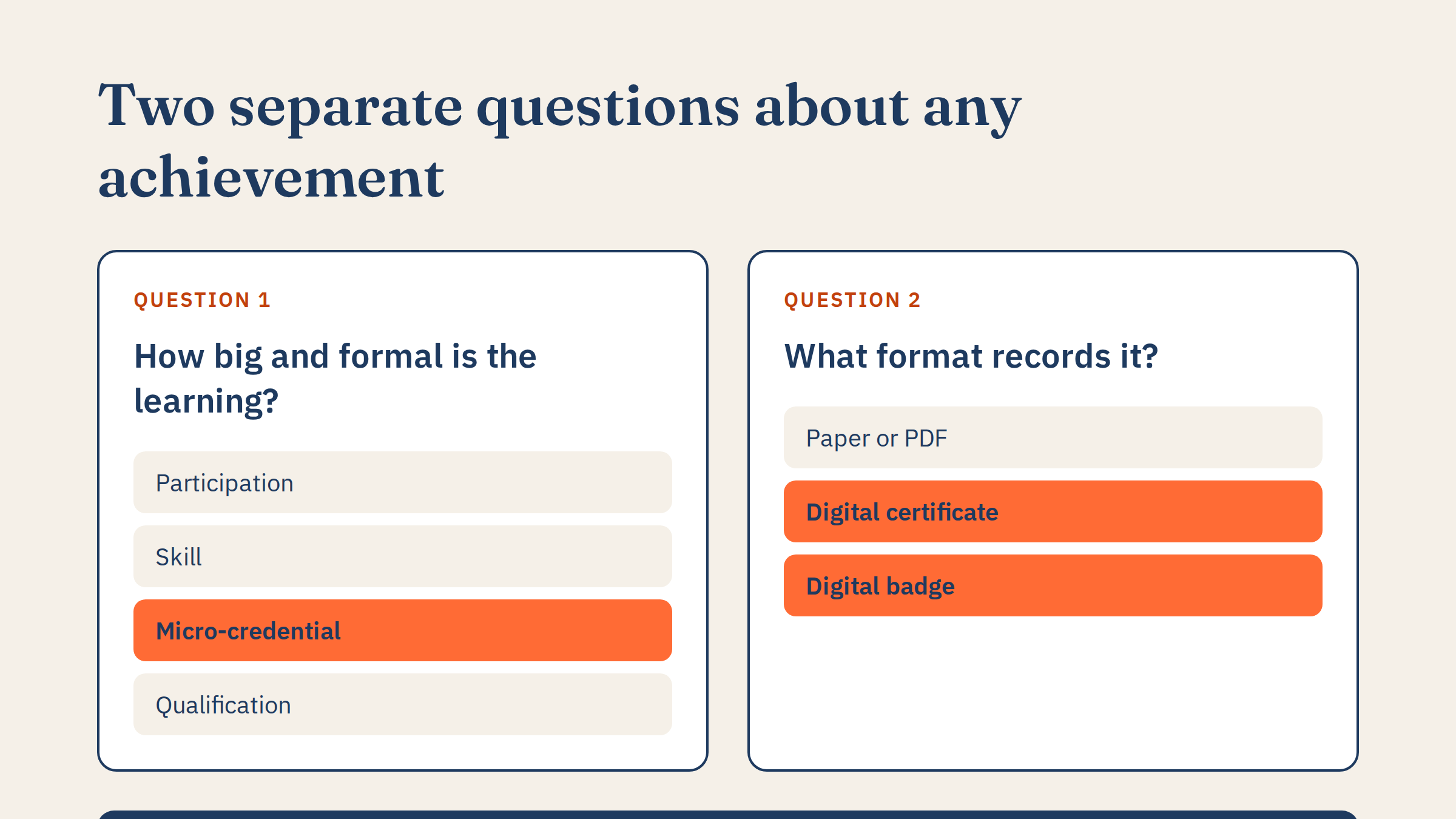
- How big and formal is the learning? Participation, a skill, a micro-credential, or a full qualification.
- What format is it recorded in? Paper, PDF, digital certificate or digital badge.
| Example | Learning | Format |
|---|---|---|
| Attended a one-day conference | Participation | Digital badge |
| Passed a 6-hour safeguarding course | Micro-credential | Digital badge and digital certificate |
| Completed a first aid course, renewed every 3 years | Skill with expiry | Digital badge with expiry date |
| Awarded a Level 3 diploma | Regulated qualification | Digital certificate, plus a badge for sharing |
Smaller achievements can also stack towards bigger ones, as in this pathway, where three module badges lead to a certificate. Module 2 covers how to design stacks and pathways.
Key takeaways
- Badges and certificates are formats; micro-credentials and qualifications describe the learning.
- Badges suit sharing online; certificates suit documents and formal records. Many issuers use both.
- A micro-credential is short, focused, assessed learning, often recorded as a badge.
- A badge can record a qualification but does not create one.