
Step 3 of 16
0 of 16 steps finished
Module 1: Digital badge foundations
Open Badges and verifiable credentials, explained simply
About 7 minutes. By the end of this lesson you can explain what the Open Badges standard is, what "verifiable credential" means, and why both matter when choosing how to issue badges.
Open Badges is the shared, open standard that most digital badges follow, so a badge issued on one platform can be read, displayed and checked on others. Its latest version, Open Badges 3.0, is built on the W3C's Verifiable Credentials standard, which lets anyone confirm a badge is genuine and unaltered without having to contact the issuer.
What is the Open Badges standard?
Open Badges is a free, public technical standard that defines what information a badge contains and how it is packaged. It was originally developed by the Mozilla Foundation and is now maintained by 1EdTech, a non-profit consortium of education and technology organisations.
A useful comparison is email. You can send an email from Gmail to Outlook because both follow the same standards. Open Badges does the same for achievements: a badge follows the earner between platforms, profiles and employers instead of being locked inside the system that created it.
What is a verifiable credential?
A verifiable credential is a digital statement, such as "this person completed this course", that is signed by its issuer so anyone can check who made it and that nobody has changed it since. The format is set out in the W3C's Verifiable Credentials Data Model 2.0, which became an official W3C Recommendation on 15 May 2025. The W3C is the international body that sets standards for the web.
The signature works like a wax seal on a letter. If anyone alters the contents, the seal breaks, and any checking tool will show it. Verifiable credentials involve three roles:
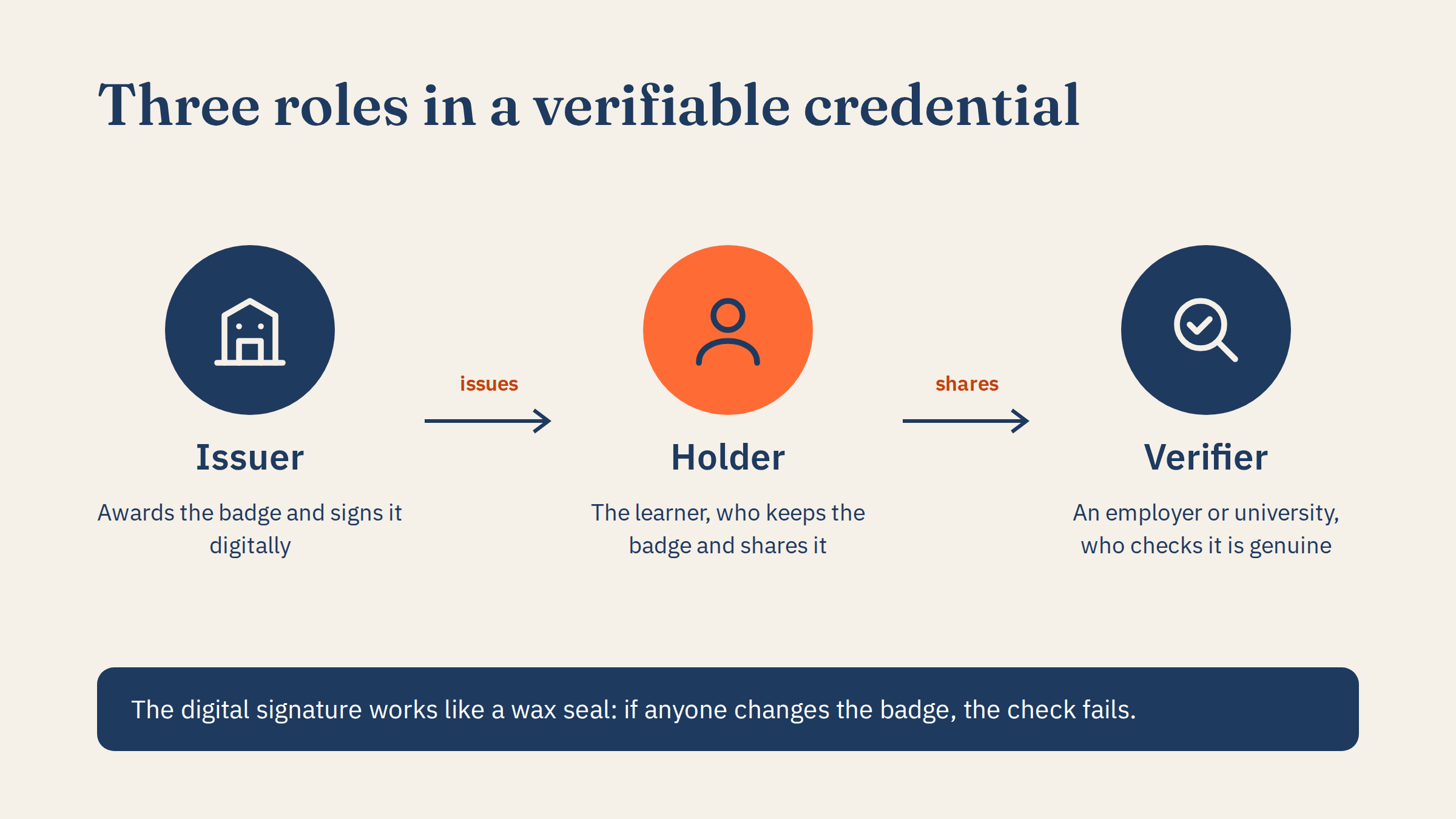
| Role | Who it is | In badge terms |
|---|---|---|
| Issuer | Makes and signs the claim | The organisation awarding the badge |
| Holder | Keeps and shares the credential | The learner who earned it |
| Verifier | Checks the credential | An employer, university or event organiser |
What changed with Open Badges 3.0?
Open Badges 3.0 turned badges into verifiable credentials. 1EdTech published it in May 2024, describing it as more tamper-proof, more portable between platforms, and able to align badges with skills frameworks.
In practice, this brings three changes:
- Stronger proof. Each badge carries a digital signature, so its authenticity can be checked mathematically.
- Learner ownership. Earners can store badges in digital wallets, much like a boarding pass in a phone wallet, and share them on their own terms.
- Independence from the issuer's platform. A badge can still be checked even if the verifier cannot reach the platform that issued it.
A new version does not retire the old one. Open Badges 2.0 remains a current, supported standard, it is what most badges in circulation today are built on, and most platforms issue and read both. Choosing 2.0 is not choosing something obsolete. 3.0 adds the verifiable credential features above for issuers who need them.
Why should an issuer care about standards?
Standards protect your learners and your investment. A badge that follows Open Badges can be displayed and checked well beyond the platform you use today, and it stays useful to learners if you ever change supplier. When comparing platforms, ask which version of Open Badges they support and whether they are listed in 1EdTech's certified products directory.
Certify issues badges to the Open Badges standard and is adopting Open Badges 3.0.
Key takeaways
- Open Badges is the open standard that lets badges work across platforms, maintained by 1EdTech.
- A verifiable credential is a signed digital claim that anyone can check for authenticity and tampering.
- Open Badges 3.0 (final in 2024) makes badges verifiable credentials, based on the W3C standard (a Recommendation since 2025).
- Choosing a standards-based platform keeps badges portable and trustworthy for learners.