
Step 2 of 16
0 of 16 steps finished
Module 1: Digital badge foundations
Inside a badge: issuer, criteria, evidence, expiry
About 7 minutes. By the end of this lesson you can name the main parts of a badge's data and explain what each one tells a viewer.
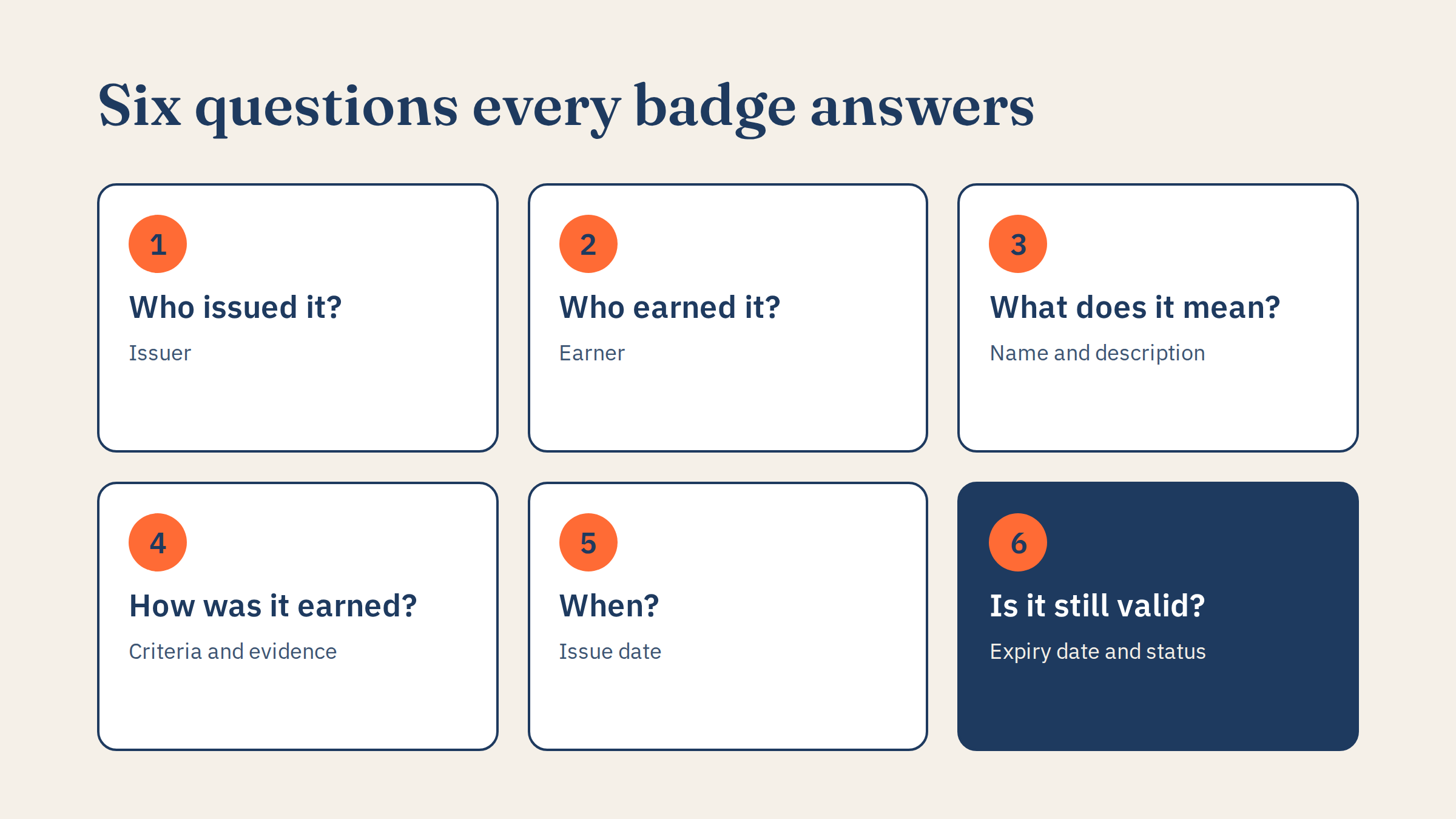
Every digital badge answers the same handful of questions: who issued it, who earned it, what it means, how it was earned, when, and whether it is still valid. These answers are stored as data inside the badge. Once you know where to look, you can judge any badge in under a minute.
What information does a badge contain?
A badge contains information about the issuer, the earner, the achievement and its criteria, plus dates and, optionally, evidence. 1EdTech's announcement of Open Badges 3.0 lists the criteria the badge was assessed against, evidence of skill, when the badge was issued and a verifiable reference to the recipient among the details issuers can include.
Here is an example badge, broken down into its parts. The organisation and person are invented for illustration.
| Part | What it answers | Example |
|---|---|---|
| Issuer | Who is vouching for this? | Northfield Training Ltd, with a link to its website |
| Earner | Who is it for? | Priya Shah, identified by her email address |
| Name and description | What does it represent? | Safeguarding Essentials: completion of a 6-hour course on recognising and reporting safeguarding concerns |
| Criteria | What did the earner have to do? | Attend all sessions, complete two case-study exercises and pass an assessment at 80% or above |
| Evidence (optional) | Can I see the work? | A link to the earner's assessed case study |
| Issue date | When was it earned? | 15 September 2026 |
| Expiry date (optional) | Is it still current? | 15 September 2029 |
| Skills or alignment (optional) | Which skills or frameworks does it map to? | A named national safeguarding framework |
Why does the issuer matter so much?
The issuer matters because a badge is only as credible as the organisation behind it. A viewer's first question is usually "do I trust whoever issued this?", so the issuer's details should be complete: a recognisable name, a website and a contact point. A badge from an unknown or vaguely named issuer invites doubt, however good the course was.
What makes good criteria?
Good criteria describe exactly what the earner did, in terms a stranger can understand. They are the difference between a badge that means something and one that means "showed up".
| Weak criteria | Strong criteria |
|---|---|
| "Completed the course" | "Completed all six modules and passed the final assessment at 80% or above" |
| "Good at Excel" | "Built a pivot-table report from a raw dataset, assessed against a published marking scheme" |
| "Attended the conference" | "Checked in to the conference and attended at least four sessions" |
A useful test: could an employer read the criteria and know what this person can now do? If not, rewrite them. Module 2 goes deeper into writing criteria.
What is evidence, and when should you include it?
Evidence is a link to the work or record that shows how the earner met the criteria, such as a project, a portfolio, an assessor's note or a video. It is optional, but it makes a badge far more persuasive, because a viewer can see the achievement rather than take it on trust. Include it when the work is presentable and the earner has agreed to it being visible.
What happens when a badge expires or is withdrawn?
An expired badge still shows that it was earned, but tells the viewer it is no longer current. Expiry suits achievements that need refreshing, such as first aid or compliance training. Issuers can also withdraw (revoke) a badge, for example if it was issued in error. Either way, anyone checking the badge sees its current status, which a paper certificate can never show.
Key takeaways
- Every badge answers: who issued it, who earned it, what it means, how, when, and whether it is still valid.
- The issuer's identity and the criteria are the two parts that most affect trust.
- Strong criteria say exactly what the earner did; evidence lets viewers see it.
- Expiry and revocation keep a badge's status accurate over time.